The U.S. Department of State has announced significant changes to immigrant visa processing that may directly affect thousands of foreign nationals worldwide. Beginning January 21, 2026, immigrant visa issuance will be temporarily paused for nationals of certain countries identified as high risk for public benefits usage. This policy update follows renewed federal emphasis on ensuring that immigrants to the United States are financially self-sufficient and do not become a public charge.
Below, we explain what this announcement means, who is affected, what exceptions apply, and how applicants can protect their immigration strategy during this pause.
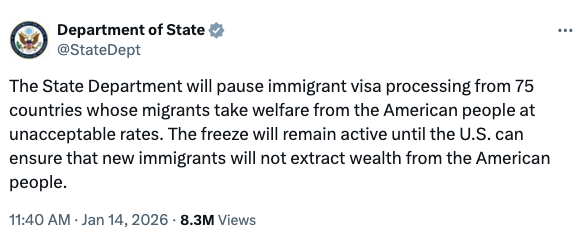
Source: U.S. Department of State – Official X account
Why the Department of State Is Pausing Immigrant Visa Issuance
President Trump has reiterated that U.S. immigration policy must prioritize financial independence and self-sufficiency. In line with this position, the Department of State is conducting a comprehensive review of existing policies, regulations, and consular guidance related to the public charge ground of inadmissibility.
As part of this review, the Department will pause the issuance of immigrant visas to applicants from countries determined to present a higher statistical risk of public benefits utilization in the United States. Importantly, this pause is procedural and does not cancel visa applications or interview appointments.
Countries Affected by the Immigrant Visa Pause
Effective January 21, 2026, immigrant visas will not be issued to nationals of the following countries:
Afghanistan, Albania, Algeria, Antigua and Barbuda, Armenia, Azerbaijan, Bahamas, Bangladesh, Barbados, Belarus, Belize, Bhutan, Bosnia and Herzegovina, Brazil, Burma, Cambodia, Cameroon, Cape Verde, Colombia, Côte d’Ivoire, Cuba, Democratic Republic of the Congo, Dominica, Egypt, Eritrea, Ethiopia, Fiji, The Gambia, Georgia, Ghana, Grenada, Guatemala, Guinea, Haiti, Iran, Iraq, Jamaica, Jordan, Kazakhstan, Kosovo, Kuwait, Kyrgyz Republic, Laos, Lebanon, Liberia, Libya, Moldova, Mongolia, Montenegro, Morocco, Nepal, Nicaragua, Nigeria, North Macedonia, Pakistan, Republic of the Congo, Russia, Rwanda, Saint Kitts and Nevis, Saint Lucia, Saint Vincent and the Grenadines, Senegal, Sierra Leone, Somalia, South Sudan, Sudan, Syria, Tanzania, Thailand, Togo, Tunisia, Uganda, Uruguay, Uzbekistan, and Yemen.
If you are a national of one of these countries, it is critical to understand how this pause may affect your case timeline and options.
Frequently Asked Questions
What happens to my immigrant visa interview appointment?
Applicants who are nationals of the affected countries may still submit immigrant visa applications and attend scheduled interviews at U.S. consulates or embassies. However, no immigrant visas will be issued to these applicants while the pause remains in effect.
Your case may remain in pending status following the interview until further guidance is issued.
Are there any exceptions to the pause?
Yes. Dual nationals who apply using a valid passport from a country not listed above are exempt from the immigrant visa pause. In such cases, careful documentation and strategic filing are essential.
Will my already issued immigrant visa be revoked?
No. According to the Department of State, no immigrant visas have been revoked as a result of this guidance. This policy applies only to future visa issuance, not to visas that have already been approved and issued.
For questions regarding entry, inspection, or admissibility at the U.S. border, the Department of State refers applicants to the Department of Homeland Security (DHS).
Does this pause affect tourist or other nonimmigrant visas?
No. This pause applies only to immigrant visas. Tourist visas, student visas, work visas, and other nonimmigrant visa categories are not affected by this policy.
How an Immigration Attorney Can Help During the Visa Pause
Even during a pause in immigrant visa issuance, strategic legal planning matters. An experienced immigration attorney can:
Assess whether you qualify for an exception, including dual nationality strategies
Prepare strong financial documentation to address public charge concerns
Monitor policy updates and consular guidance in real time
Explore alternative immigration pathways or nonimmigrant options
Ensure your case is positioned for immediate action once the pause is lifted
Final Thoughts
Immigration policies can change quickly, and pauses like this often evolve into new long-term requirements. If you or a family member may be impacted by the January 2026 immigrant visa pause, early legal guidance is critical.
For personalized advice on how this policy affects your immigration goals, consult a qualified U.S. immigration attorney who can help you navigate uncertainty and protect your future.
Stay Informed on the 2026 Immigrant Visa Processings
Recent U.S. immigration policy changes now directly affect immigrant visa issuance for nationals of certain countries, even when interviews are scheduled and applications are otherwise complete. If you or a family member may be impacted by the January 2026 immigrant visa pause—or are facing delays, pending cases, or uncertainty due to public charge concerns—experienced legal guidance is critical.
📞 Contact the Law Firm of Anna Korneeva at (513) 334-3008 to review your immigration options, assess possible exceptions, and ensure your case is positioned for action once visa issuance resumes.