Immigration applicants should pay close attention to the edition date printed on their USCIS forms this September.
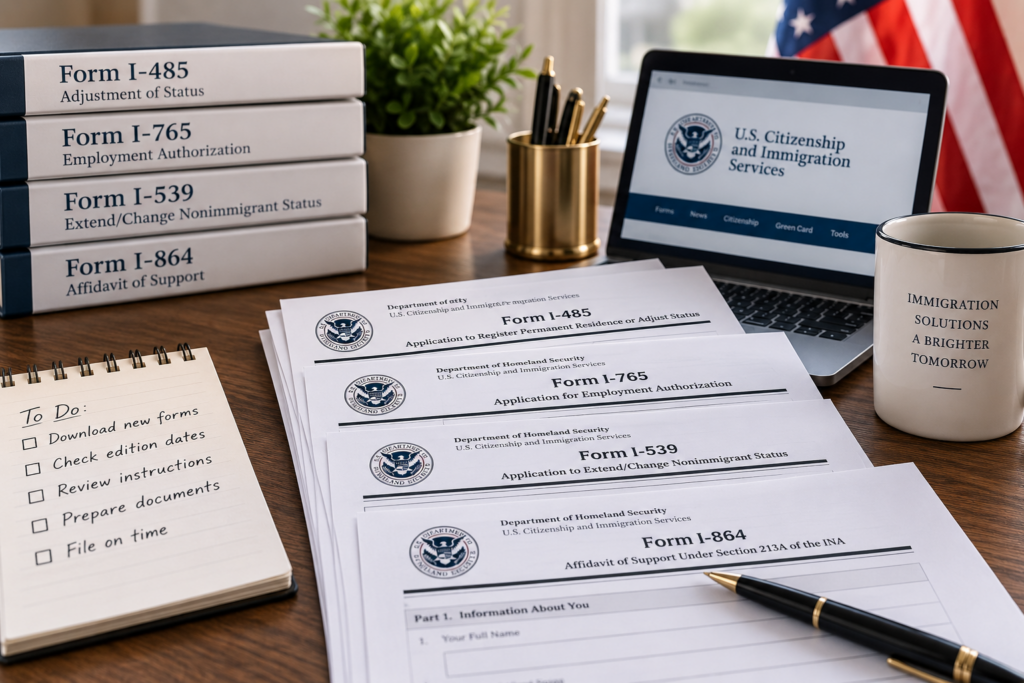
U.S. Citizenship and Immigration Services (USCIS) is implementing revised editions of several commonly used immigration forms, including Form I-485, Form I-539, and Form I-765. Separately, USCIS recently implemented new editions of Forms I-864, I-864A, and I-864EZ without a grace period, prompting litigation from the American Immigration Lawyers Association (AILA) and co-counsel.
For applicants, the practical concern is significant: filing an outdated edition after the applicable deadline may result in USCIS rejecting the filing.
New Form I-485 Takes Effect September 18
USCIS announced that a revised edition of Form I-485, Application to Register Permanent Residence or Adjust Status, will become available on September 18, 2026.
The revised form is being introduced in connection with the new public charge rule that also takes effect September 18.
Most importantly, USCIS has announced that there will be no grace period for the previous Form I-485 edition. Beginning September 18, USCIS will reject older editions of Form I-485.
This makes the timing of adjustment-of-status filings especially important for applicants preparing to submit their green card applications around the transition date.
Forms I-539 and I-765 Are Also Changing
Two other frequently used immigration forms are scheduled to change even earlier.
Beginning September 15, 2026, revised editions of the following forms are expected to take effect:
- Form I-539 — Application to Extend/Change Nonimmigrant Status
- Form I-765 — Application for Employment Authorization
The changes may be particularly relevant to international students, exchange visitors, certain nonimmigrant workers, and individuals applying for employment authorization.
The new editions should not be filed before September 15. At the same time, USCIS is not providing an overlap period after the transition: the previous editions will no longer be accepted for filings made on or after September 15.
Changes to Affidavit of Support Forms Have Led to a Lawsuit
USCIS has also implemented new editions of several forms used in the financial sponsorship process.
On August 31, 2026, USCIS implemented new editions of Form I-864, Form I-864A, and Form I-864EZ without advance warning or a grace period.
AILA and immigration law firm Benach Pitney Reilly subsequently filed a lawsuit challenging the implementation of those changes. The lawsuit concerns USCIS’s decision to require the new editions without providing advance notice or a transition period.
Because litigation is ongoing, applicants and sponsors should verify the current USCIS requirements before submitting an Affidavit of Support.
Why the Edition Date Matters
When USCIS changes a form, using an outdated edition can create more than a paperwork inconvenience.
A rejected filing may require an applicant to prepare and submit the package again. Depending on the type of immigration benefit involved, a delay could also create problems involving filing deadlines, immigration status, employment authorization, or other time-sensitive issues.
Applicants should therefore avoid relying on forms that were downloaded weeks or months earlier without checking whether USCIS has since published a newer edition.
What Should Applicants Do Before Filing?
Before submitting an immigration application or petition during this transition period, applicants should:
- Verify the current edition date directly with USCIS.
- Confirm which edition is accepted on the date of filing.
- Avoid assuming USCIS will provide a grace period for an older form.
- Carefully review updated form instructions.
- Check all supporting documents before submitting the filing.
- Consider filing timelines carefully when approaching a form-change deadline.
This is particularly important for filings being prepared close to September 15 or September 18, 2026.
Need Help Preparing Your USCIS Filing?
USCIS forms and filing requirements can change quickly, and submitting the wrong edition may result in a rejected application.
If you are preparing an adjustment-of-status application, employment authorization request, extension or change of status, Affidavit of Support, or another immigration filing, reviewing the current requirements before submission can help avoid unnecessary delays.
📞 Contact the Law Firm of Anna Korneeva at (513) 334-3008 to discuss your immigration case and ensure your application is prepared under the current USCIS filing requirements.
Disclaimer: This article is for general informational purposes only and does not constitute legal advice. USCIS forms, filing requirements, deadlines, and policies may change. Applicants should verify current USCIS requirements and consult a qualified immigration attorney regarding their individual circumstances.
Articles Based on: American Immigration Lawyers Association. (2026, August 19). USCIS Announces New Edition of Form I-485 Effective 9/18/26. AILA Doc. No. 26081963;