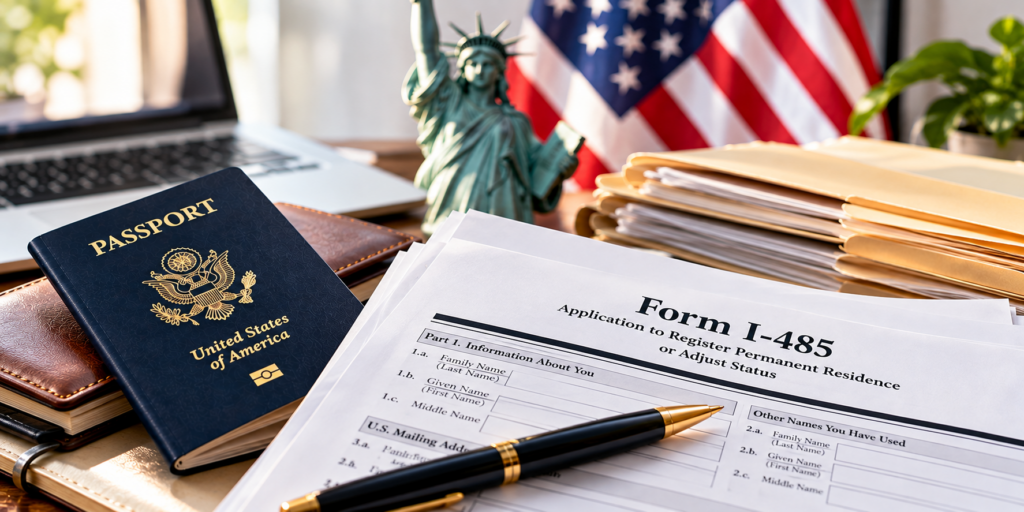
Applying for lawful permanent residence through adjustment of status now requires careful attention to the new public charge rule and the updated edition of Form I-485, Application to Register Permanent Residence or Adjust Status.
The Department of Homeland Security’s new public charge final rule became effective on September 18, 2026. On that same date, USCIS introduced a revised edition of Form I-485 designed to reflect the new requirements. USCIS has stated that older editions submitted on or after September 18 will be rejected, with no grace period for using the previous edition.
On September 28, 2026, the American Immigration Lawyers Association (AILA) published a new Practice Pointer addressing practical considerations for filing Form I-485 under these requirements.
What Changed With the Public Charge Rule?
DHS’s 2026 final rule rescinded the 2022 public charge regulation and restored broader discretion to immigration officers when determining whether an applicant is likely at any time to become a public charge.
USCIS also updated its Policy Manual guidance regarding public charge determinations. The guidance addresses who is subject to the public charge ground of inadmissibility, who may be exempt, what factors and evidence officers may consider, and the public charge bond process.
These changes became effective on September 18, 2026.
A New Edition of Form I-485 Is Required
One of the most important practical changes for adjustment-of-status applicants is the revised Form I-485.
USCIS announced that the new edition became effective September 18, 2026 and that beginning on that date it would reject older editions without a grace period.
That makes checking the form edition particularly important before submitting an adjustment-of-status application.
Applicants should not assume that a previously downloaded or prepared Form I-485 remains acceptable.
Public Benefits Require Careful Review
AILA’s September 28 Practice Pointer specifically highlights screening for means-tested benefits as an important consideration when preparing Form I-485 under the new rule.
This does not mean that every applicant who has received a public benefit will automatically be found inadmissible.
Public charge determinations depend on the applicable law and the individual’s circumstances. USCIS guidance addresses both individuals subject to the public charge ground of inadmissibility and categories that are exempt.
Applicants should therefore avoid making assumptions about how receiving a particular benefit will affect their case and should carefully review their circumstances before filing.
Initial Evidence Is Important
The AILA Practice Pointer also identifies the submission of initial evidence as an important issue under the new filing framework.
A Form I-485 filing is more than completing the form itself. Depending on the applicant’s immigration category and individual circumstances, supporting evidence may be necessary to establish eligibility and address applicable public charge requirements.
Submitting an incomplete application or overlooking required evidence may result in delays, requests for additional evidence, or other complications.
Be Careful When Filing Form I-485 Online
Electronic filing also requires attention.
AILA previously highlighted an important issue for applicants using myUSCIS: the online system uses Coordinated Universal Time (UTC) to determine filing dates. Form I-485 electronic filings are also submitted through the system as PDF uploads, which means applicants should avoid waiting until the last minute to complete a time-sensitive filing.
Applicants should confirm that their filing has been properly submitted and retain copies of their forms, supporting documents, and filing records.
What Should Applicants Do Before Filing?
Before submitting Form I-485 under the new public charge framework, applicants should carefully:
- Confirm they are using the correct 09/18/26 edition of Form I-485.
- Determine whether the public charge ground of inadmissibility applies to their immigration category.
- Carefully review questions concerning public benefits.
- Gather appropriate supporting and initial evidence.
- Review the entire application for consistency and accuracy.
- Avoid waiting until the last minute when submitting electronically.
- Keep copies of the complete filing and supporting documents.
Because adjustment-of-status cases can vary significantly, the requirements that apply to one applicant may not apply in the same way to another.
Why These Changes Matter for Green Card Applicants
The September 2026 changes affect both the substance of public charge determinations and the mechanics of filing Form I-485.
The new public charge framework gives USCIS broader discretion than under the rescinded 2022 regulation, while the revised Form I-485 creates immediate procedural requirements for new adjustment-of-status filings.
Applicants should therefore make sure they are relying on current forms and current guidance rather than older filing instructions.
If you are preparing to apply for adjustment of status or are concerned about how the new public charge requirements may affect your case, obtaining individualized legal advice before filing can help you understand the requirements that apply to your circumstances.
📞 Contact the Law Firm of Anna Korneeva at (513) 334-3008 to discuss your immigration situation and options.
Articles Based on: U.S. Department of Homeland Security. (2026, July 20). Public Charge Ground of Inadmissibility. 91 Fed. Reg. 45324.; U.S. Citizenship and Immigration Services. Form I-485, Application to Register Permanent Residence or Adjust Status.
Disclaimer: This article is for general informational purposes only and does not constitute legal advice. Immigration laws, regulations, forms, filing procedures, and agency policies may change. The information above is based on the DHS public charge final rule, USCIS guidance, and AILA materials available as of October 2026. Consult a qualified immigration attorney regarding your individual circumstances.