Immigration law uses many terms that sound similar but have very different legal meanings. Two of the most commonly confused terms are “lawful presence” and “lawful status.”
These phrases are often used interchangeably in everyday conversation, but they are not the same. Understanding the difference can be very important for noncitizens, families, employers, students, and anyone applying for an immigration benefit in the United States.
A person may be allowed to remain in the United States for a certain period of time without necessarily having a formal immigration status. In other cases, a person may have lawful status but still need to follow strict rules connected to that status. The consequences of misunderstanding the difference can be serious.
What is lawful immigration status?
Lawful immigration status generally means that a person has been admitted to the United States in a recognized immigration classification or has been granted a specific immigration status under U.S. immigration law.
Examples of lawful immigration status may include:
- Lawful permanent resident status;
- H-1B worker status;
- F-1 student status;
- B-1/B-2 visitor status;
- L-1 intracompany transferee status;
- Asylee or refugee status;
- Certain other immigrant or nonimmigrant classifications.
A person in lawful status usually has specific rules they must follow. For example, a visitor generally cannot work in the United States. An F-1 student must comply with student visa requirements. An H-1B worker must work according to the terms of the approved petition.
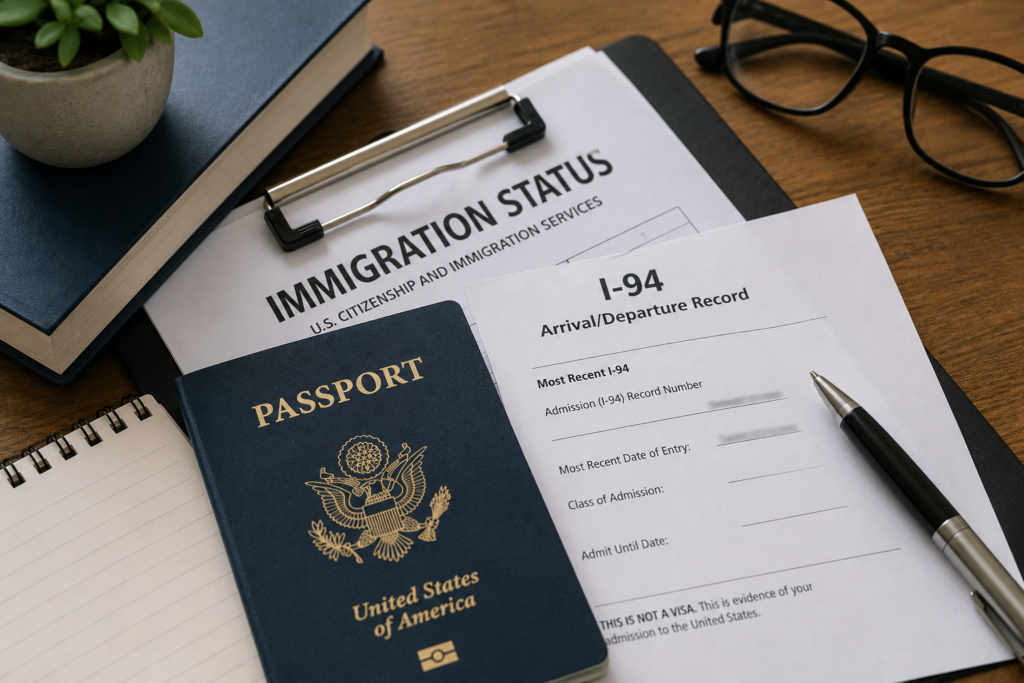
The Form I-94 Arrival/Departure Record is often one of the most important documents for determining how long a person is authorized to stay in the United States. For many nonimmigrants, the I-94—not the visa stamp in the passport—controls the authorized period of stay.
What is lawful presence?
Lawful presence is a different concept. It generally refers to a period when the U.S. government permits a person to remain in the United States, even if that person does not have a formal immigration status.
This is sometimes called a “period of authorized stay.”
A person may be lawfully present without being in lawful status. This distinction is especially important in cases involving pending immigration applications, deferred action, parole, or other temporary protections.
For example, a person with a properly filed and pending adjustment of status application may be allowed to remain in the United States while USCIS reviews the case. That does not always mean the person has a new lawful immigration status. It may mean the person is in a period of authorized stay while the application is pending.
Can someone be lawfully present but not in lawful status?
Yes. This is one of the most important points to understand.
A person can be lawfully present in the United States without holding formal lawful immigration status.
Common examples may include:
- A person with a pending Form I-485 adjustment of status application;
- A person granted deferred action;
- Some parolees;
- Certain applicants with timely filed extension or change of status requests;
- Certain individuals protected from accruing unlawful presence while an application is pending.
This can be confusing because the person may have permission to stay temporarily, and may even have employment authorization in some cases, but still may not have lawful immigration status.
A work permit does not automatically mean lawful status. Employment authorization allows a person to work legally for a certain period of time, but it does not always create or prove a separate immigration status.
Why does the difference matter?
The difference between lawful presence and lawful status can affect many immigration issues, including:
- Eligibility for adjustment of status;
- Whether a person is considered out of status;
- Whether unlawful presence is accruing;
- Whether the three-year or ten-year unlawful presence bars may apply;
- Eligibility for certain immigration benefits;
- Driver’s license or state benefit issues;
- Work authorization questions;
- Travel risks;
- Future visa or green card options.
A person may mistakenly believe that being lawfully present means they are fully protected for every immigration purpose. That is not always true. Lawful presence may prevent unlawful presence from accruing, but it may not solve other immigration problems.
Likewise, a person may assume they are unlawfully present simply because their prior status expired. In some cases, a pending application or another authorized stay may prevent unlawful presence from accruing.
Because the legal consequences can be very different, it is important to review the exact facts of each case.
What does “out of status” mean?
Being “out of status” generally means that a person no longer complies with the terms of the immigration classification under which they were admitted or approved.
For example, a visitor who works without authorization may violate visitor status. A student who stops attending school may fall out of F-1 status. A worker whose employment ends may no longer be maintaining the required work-authorized status.
Being out of status can create serious immigration consequences. It may affect eligibility for adjustment of status, future visa applications, or other immigration benefits. However, being out of status does not always mean the person is accruing unlawful presence at that exact moment.
That is why legal analysis matters.
What is unlawful presence?
Unlawful presence generally refers to time spent in the United States without being admitted or paroled, or after the expiration of a period of stay authorized by the government.
Unlawful presence is especially important because it can trigger serious bars to returning to the United States after departure.
In general, a person who accrues more than 180 days but less than one year of unlawful presence and then departs the United States may face a three-year bar. A person who accrues one year or more of unlawful presence and then departs may face a ten-year bar.
These rules are technical and have exceptions. Before traveling outside the United States, anyone with possible unlawful presence should speak with an immigration attorney.
Common example: pending adjustment of status
One common situation involves a person who files Form I-485 for adjustment of status while in the United States.
For example, someone may enter the United States in valid nonimmigrant status and later apply for a green card. If the prior status expires while the I-485 is pending, the person may no longer have that original nonimmigrant status. However, the pending adjustment application may place the person in a period of authorized stay.
That distinction matters. The person may be allowed to remain in the United States while the green card application is pending, but they should not assume that the pending I-485 gives them a new lawful status for every purpose.
This can affect travel, employment, future applications, and strategy if the case is denied.
Common example: deferred action and DACA
Deferred action is another area where lawful presence and lawful status are often confused.
A person granted deferred action may be considered lawfully present for certain purposes during the deferred action period. They may also be eligible to apply for employment authorization. However, deferred action generally does not create lawful immigration status.
This distinction is important for DACA recipients and others with deferred action because their legal options may depend on many additional facts, including entry history, travel history, family relationships, employment-based options, and any prior immigration violations.
Why terminology matters
Words matter in immigration law. “Lawful status,” “lawful presence,” “authorized stay,” “out of status,” and “unlawful presence” are not just labels. Each term can affect real-life decisions.
Using the wrong term can lead to mistakes such as:
- Traveling internationally when it is risky;
- Assuming a work permit creates lawful status;
- Missing a filing deadline;
- Filing the wrong application;
- Misunderstanding green card eligibility;
- Triggering unlawful presence bars;
- Failing to preserve immigration options.
For this reason, it is important to get legal advice before making decisions based on general information.
When should you speak with an immigration attorney?
You should consider speaking with an immigration attorney if:
- Your I-94 is expired or about to expire;
- You have a pending Form I-485, I-539, I-589, or other immigration application;
- You are unsure whether you are in lawful status;
- You have been told you are lawfully present but not in status;
- You have a work permit but no clear immigration status;
- You are considering international travel;
- You may have accrued unlawful presence;
- You are applying for a green card;
- You received a USCIS denial, RFE, or Notice of Intent to Deny;
- You are trying to understand whether consular processing or adjustment of status is safer.
Small timing issues can have major immigration consequences. A careful review of your immigration history can help identify risks and protect future options.
Need Help Understanding Lawful Presence, Lawful Status, or Unlawful Presence?
Immigration status questions can have serious consequences, especially if your Form I-94 has expired, you have a pending application, you hold a work permit, or you are unsure whether you are lawfully present, in lawful status, out of status, or accruing unlawful presence. These distinctions can affect green card eligibility, travel, work authorization, consular processing, adjustment of status, and future immigration options.
📞 Contact the Law Firm of Anna Korneeva at (513) 334-3008 to review your immigration history, evaluate your lawful presence or lawful status concerns, and take timely steps to protect your path forward in the United States.
This article is for general informational purposes only and does not constitute legal advice. Immigration law is highly fact-specific, and the rules regarding lawful presence, lawful status, and unlawful presence can be complex. You should consult a qualified immigration attorney before making decisions about your immigration case. Article Based on American Immigration Lawyers Association. (2026, July 9). Think Immigration: Lawful Presence vs. Lawful Status – What’s the Difference? AILA.